
The Botanical Source
Natural camphor has historically been obtained from camphor-bearing trees, especially Cinnamomum camphora. The aromatic compound is present in plant material and essential oil. Exact harvesting and processing practices vary by region, producer and chemotype, so a finished retail product should not be traced to a specific farm or species unless the supplier has documentation for that claim.
Steam Distillation
In a traditional production route, prepared wood and other suitable plant material are exposed to steam. Heat releases volatile aromatic compounds, and the vapour is carried into a condenser. Cooling turns the vapour into a mixture from which camphor-rich material can be separated. This is an upstream industrial or agricultural process, not something performed while assembling a Lumora jar.
Crystallisation And Purification
The collected material is refined so camphor crystallises from the aromatic mixture. Repeated purification can remove non-camphor components and improve consistency. Natural camphor is associated with a particular optical form, while industrial synthetic camphor is commonly a racemic mixture. Specialist methods such as chromatography and optical-rotation testing are more meaningful than household flame tests when origin or composition must be verified.
From Crystals To Soft Slabs
After purification, camphor may be supplied in crystalline masses, slabs, powder or other commercial forms. Bhimseni camphor used for household rituals is often sold as translucent, irregular pieces. Those pieces can be soft enough to break by hand, but texture and appearance still do not replace batch records or analytical evidence.
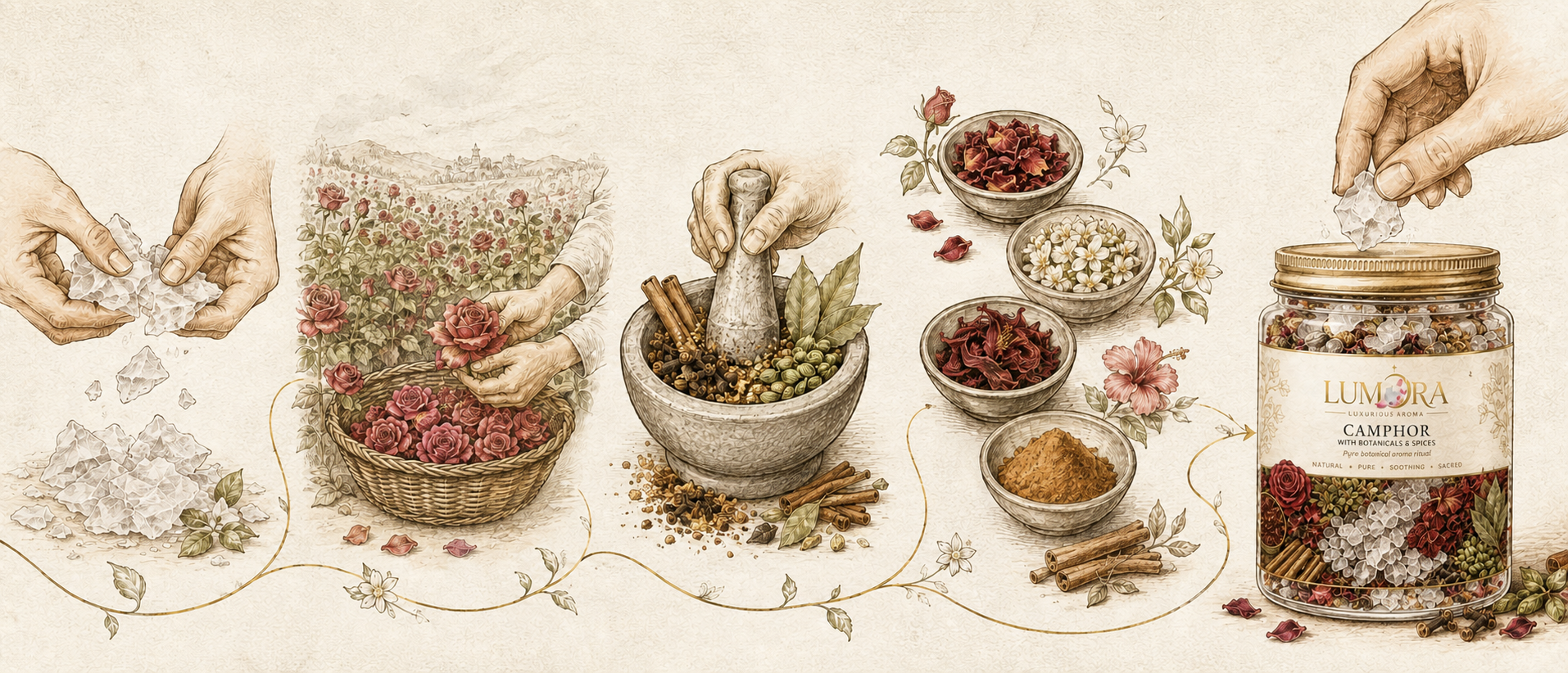
How A Lumora Jar Is Assembled
Lumora’s making process begins after sourced Bhimseni camphor is received. Soft slabs are broken into usable pieces. Cinnamon, elaichi, clove and bay leaf are crushed, while dried Rose, Jasmine, Hibiscus or Sandalwood is prepared as a separate botanical choice. Each batch is blended gently and placed in the jar.
Why Transparency Matters
A responsible story separates general education about natural camphor extraction from the actual steps performed by the brand. Customers should be able to see the declared ingredients, understand the retail product’s intended use and contact the marketer with questions. That kind of traceability is more useful than an unsupported farm-to-home claim.
Choose a Lumora Botanical Camphor Ritual
Begin with the 75g Bhimseni Botanical Gift Pack, including a jar and ceramic burner, or replenish your ritual with the 150g botanical camphor refill pouch or 300g botanical camphor refill pouch. You can also follow how a Lumora jar is made, from the soft camphor pieces and botanicals to the finished blend.